UASU Warns Public Universities on Brink of Crisis as Union Issues Government One-Month Ultimatum
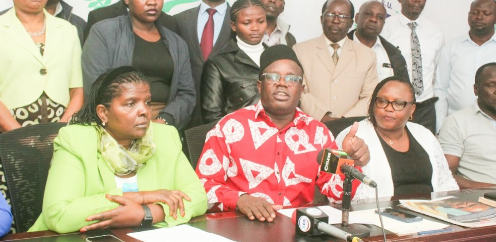
Speaking to the media on Friday, September 18, 2026, UASU Secretary General Dr Constantine Wasonga said the situation required urgent government intervention before the challenges cause irreversible damage to university education.
At the centre of the union’s concerns is the failure to conclude the 2025-2029 Collective Bargaining Agreement (CBA), which UASU says has remained unresolved despite an agreement reached under the November 2025 Return-to-Work Formula to complete negotiations before the end of last year.
According to the union, nearly a year later, the Inter-Public Universities Councils Consultative Forum (IPUCCF) and the Government have yet to table a financial counter-proposal.
UASU has now given the Government and IPUCCF one month from September 18 to table a substantive counter-proposal, negotiate, sign and implement the 2025-2029 CBA.
The union also took issue with the funding model for public universities, arguing that salaries of academic staff should be protected through Exchequer funding rather than being financed primarily from student fees.
UASU said the recently published Tertiary Education, Placement and Funding Bill, 2026, does not adequately address the mechanism for remunerating academic staff.
“It is unsustainable to finance the salaries of university professors from student fees,” the union said, calling for any legislation on public university financing to contain a clear provision safeguarding academic staff remuneration from the Exchequer.
The union further accused the Salaries and Remuneration Commission (SRC) of becoming a roadblock to the implementation of internal CBAs negotiated between individual universities and UASU chapters.
UASU cited the University of Nairobi’s 2017-2021 CBA, which it said was signed after nine years of negotiations, but which SRC has subsequently challenged by proposing that academic staff forgo the agreement.
The union wants SRC to establish a practical mechanism through which signed internal CBAs can be registered and implemented.
Another major concern is the growing reliance on part-time lecturers, which UASU says has become a substitute for employing permanent academic staff.
The union argued that increasing student enrolment has not been matched by recruitment of permanent lecturers, leaving existing academic staff with excessive workloads while universities increasingly depend on insecure employment arrangements.
UASU wants universities to review their part-time teaching policies and ensure part-time lecturers are not used to replace established permanent positions. It also wants eligible part-time lecturers absorbed into available permanent positions.
The union has also opposed what it described as continuing attempts to reduce the retirement age of academic staff in breach of the existing CBA.
UASU questioned the rationale of forcing experienced academics out of permanent employment while universities simultaneously rely on part-time lecturers to fill teaching gaps.
“It takes decades to produce a professor, and Kenya has fewer than 2,000 professors,” the union said, warning that the retirement of experienced academics could result in the loss of significant intellectual capital.
UASU linked the retirement-age dispute to the wider pension crisis facing public universities, claiming that universities collectively owe pension schemes more than KSh20 billion in remittances and related obligations.
The union warned that premature retirement of academic staff could further strain pension schemes already facing financial challenges.
At Moi University, UASU demanded an immediate suspension of the ongoing redundancy process, arguing that the institution’s staffing situation contradicts the decision to reduce its workforce.
The union cited reports by regulatory bodies indicating that Moi University is severely understaffed, while the institution has also advertised for part-time lecturers.
UASU wants the Government to commission an independent staffing audit at the university and suspend all redundancy notices pending the outcome.
Wasonga said the Government must address the concerns urgently to protect the quality of university education, the welfare of academic staff and the interests of students.
“Public universities are in crisis,” UASU said, calling for immediate action on the CBA, university financing, staffing, part-time teaching, retirement age and the Moi University redundancy