CBA 2025–2029: A Stronger Future for Kenya
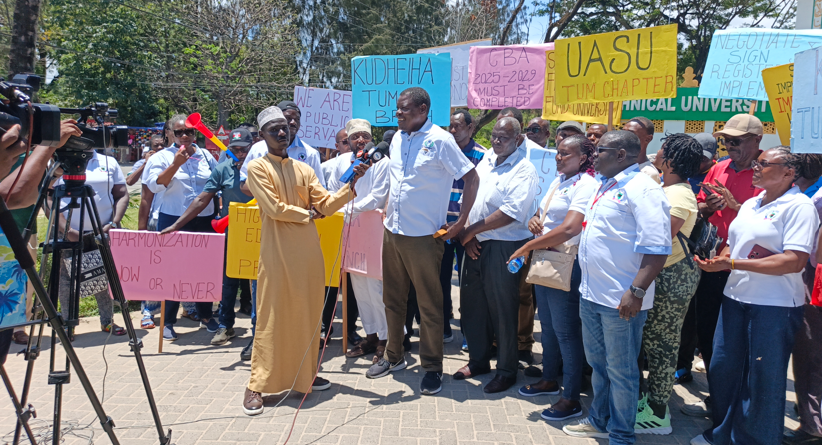
📢 AS THE STRIKE ENTERS WEEK THREE, LECTURERS URGE GOVERNMENT TO FUND, CONCLUDE AND HONOUR THE PROPOSED COLLECTIVE BARGAINING AGREEMENT IN ITS TOTALITY
✍️ By Dr. Dynesius Nyangau
The 2025–2029 Collective Bargaining Agreement (CBA) should be assessed not only by its immediate fiscal cost, but also by what it enables public universities to deliver to learners, communities and the country over time.
Its proposed salary increments, harmonised allowances, predictable public funding, mortgage facilities and car-loan schemes are investments in the people who teach, supervise, research, innovate and sustain our universities. Their benefits extend beyond university employees to present and future generations of Kenyans.
📊 The proposals set out nominal amounts or rates for individual items, making them capable of objective costing and evaluation. Government should therefore assess the full package against the quality and value of university work and its direct and indirect benefits to the nation.
⚠️ A payroll figure alone cannot measure the cost of prolonged disruption: interrupted semesters, delayed graduations, lost teaching and research time, uncertainty for students and families, pressure on university finances, and damage to institutional confidence. Nor can it capture the public value of stable, skilled university staff.
💰 1. Salary Increments That Protect Purchasing Power
The Kenya National Bureau of Statistics (KNBS) reported annual consumer-price inflation of 6.8% in September 2026. The employer’s reported offer of 3% annual increments would fall below that latest measure.
📉 If prices rose by 6.8% while pay increased by 3%, the real value of pay would fall by approximately 3.6% over that year. This is an illustration based on the latest annual inflation rate, not a prediction that inflation will remain constant.
The principle is straightforward: salary adjustments should respond to the cost of living and recognise employees’ skills, workload, experience and contribution. A nominal increase that leaves workers less able to meet basic costs is not a meaningful improvement in remuneration.
🎓 Fair and adequate pay also serves the public. It helps universities recruit and retain qualified lecturers, reduces avoidable staff turnover, and supports continuity in teaching, supervision and research.
🔬 Research capacity, innovation and professional training strengthen public institutions, the labour force and national development. These benefits accrue to future citizens as well as to the students and communities served today.
⚖️ 2. Harmonised Allowances for Fairness Across Public Universities
Allowances should be reviewed and harmonised across public universities according to transparent and defensible criteria, including job value, grade, responsibility and relevant location costs.
🤝 Harmonisation does not necessarily mean identical amounts where objective differences justify different rates. It means that comparable work is treated fairly, differences are explained, and no university’s staff are disadvantaged by arbitrary or historically entrenched disparities.
📜 This principle is consistent with Article 27 of the Constitution, which guarantees equality and freedom from discrimination; Article 41, which protects fair labour practices and fair remuneration; and the principle under the Salaries and Remuneration Commission (SRC) Act of equal remuneration for work of equal value.
🏠 Housing and commuter allowances affect staff members’ ability to live near their workplaces, travel to campuses and perform their responsibilities effectively.
The petition records that house allowance had not been reviewed since 2010 and that the employer’s offer did not address an increase. If rates have remained unchanged, their purchasing power has steadily eroded.
✅ A regular and transparent review would promote fairness, improve staff morale and support more consistent employment conditions across the university sector.
🏛️ 3. Predictable Exchequer Funding for Public Universities
Public universities provide an essential public service and require dependable funding to meet the employment obligations they negotiate.
💵 Staff remuneration should not be left exposed to unpredictable student-fee income or funding arrangements that leave universities uncertain about their ability to meet recurrent costs. The case for Exchequer support is a case for predictable, transparent public funding of a public mandate.
📜 The constitutional position must be stated carefully. The Constitution does not require every public university to use an identical accounting route. Article 206 recognises legally authorised public funds and retained revenues, as well as the Consolidated Fund. However, public money must be managed lawfully, and withdrawals from the Consolidated Fund must be supported by appropriation or another authorised route.
Government can and should make adequate provision for the agreed university wage bill through the budget process.
🎓 Student scholarships and loans are essential for access to education, but they are not a substitute for reliable institutional funding for staff, teaching and research. The Universities Fund already has a statutory role in university financing and in developing transparent criteria for allocating and mobilising resources.
🌍 A well-funded university sector also serves the nation over the long term. It develops skilled professionals, educators and public leaders; generates research and evidence for policy; supports innovation and enterprise; and contributes to national productivity.
🌱 When the State funds these institutions predictably, the return is not confined to the current budget year. It is reflected in the knowledge, capacities and opportunities passed on to future generations.
🏠 4. Mortgage and Car-Loan Facilities: Understanding the Real Cost
The proposed CBA provides for mortgage and car loans at 3% per annum on a reducing balance.
🚗 The clauses still require operational details, including loan ceilings, eligibility criteria, repayment periods, risk-sharing arrangements and administration. These are matters for the negotiating parties to resolve through transparent costing, not reasons to dismiss the potential benefits without proper analysis.
💳 The principal advanced under a loan is generally recoverable. If a financial institution provides the capital and repayments are collected through payroll, the public cost may be limited to administration, a capped guarantee or an interest subsidy.
🔄 If Government provides capital through a revolving fund, the initial cash requirement is higher, but repayments can replenish the fund.
📊 The true fiscal cost therefore depends on take-up, the cost of capital, defaults and administration. It is not automatically equal to the total value of all loans.
🏡 These facilities can help staff access secure housing and reliable transport, support retention and reduce financial pressure. They may also circulate funds into housing construction, transport and related local economic activity.
🔎 These outcomes are not automatic. The scheme requires fair access, responsible lending and proper oversight. Nevertheless, they are valid potential benefits and should form part of a comprehensive cost-benefit assessment.
📈 5. Putting the CBA Costs into National Budget Perspective
For perspective, the approved FY2026/27 national budget is reported at KSh 4.82 trillion, including KSh 781.3 billion for education.
🏛️ The detailed estimates allocate approximately KSh 2.0 billion to the Parliamentary Service Commission’s own vote, distinct from the approximately KSh 50.8 billion allocated to Parliament as a whole.
💡 A hypothetical KSh 1 billion loan-capital facility would represent approximately 0.021% of the national budget and 0.128% of the education budget.
⚠️ This is a gross capital comparison, not the net cost of a repayable revolving facility.
💰 Parliament has also provided KSh 6.6 billion for university CBA arrears in FY2026/27. While this does not fund the entire new CBA, it demonstrates that university CBA obligations can be addressed through public budgeting.
✅ The Government should therefore evaluate the proposed agreement using transparent costing, credible funding arrangements and a full assessment of the economic and social benefits of a stable university sector.
🇰🇪 6. The Constitutional and Moral Responsibility of Government
📜 The Constitution recognises education as a right under Article 43 and makes the best interests of children paramount under Article 53(2).
⚖️ Article 21 places a duty on the State and every State organ to respect, protect, promote and fulfil rights. Article 41 protects fair labour practices, fair remuneration, reasonable working conditions and collective bargaining.
🤝 Articles 10 and 232 require public institutions to uphold equity, social justice, accountability, efficient use of resources and responsive, effective public service.
🎓 Public universities cannot reliably discharge their obligations to learners while the employment conditions and financing of the staff who teach and support them remain unresolved.
💼 Article 201 requires prudent and accountable public finance. Articles 206, 221 and 223 provide lawful routes for appropriations and supplementary spending.
These rules require proper budgeting and accountability; they do not excuse indefinite delay or the absence of a credible offer.
📢 Government should disclose the costs, identify the funding path, make the necessary budget provision and implement the settlement responsibly.
The SRC’s duty to consider fiscal sustainability must be weighed alongside fairness, transparency, productivity and the need to attract and retain skills in public service.
📝 7. Collective Bargaining Must Lead to an Enforceable Agreement
⚖️ Article 41 does not make every proposal in a union draft automatically binding. However, it protects collective bargaining, while section 59(5) of the Labour Relations Act provides for the enforceability of a collective agreement upon registration.
⏳ In the current context—after repeated delays, return-to-work commitments and the disruption now being borne by workers, students and families—the only course that is right, legally coherent and morally defensible is for Government to grant the proposed 2025–2029 CBA in its totality, provide the necessary lawful funding and honour the agreement once concluded and registered.
📌 The ongoing strike reflects a wider concern about the need for credible commitments, fair employment conditions and reliable financing for public universities.
🔍 A sustainable resolution requires more than an assessment of the immediate payroll bill. It requires Government and the relevant parties to consider the full package, agree on a lawful funding mechanism and deliver a settlement that restores confidence in collective bargaining.
✊ 8. Week Three: Our Resolve and Solidarity Must Remain Unshaken
📢 LECTURERS ACROSS THE REPUBLIC: LET US STAY PUT.
As we enter week three of our struggle, we must remain united until Government commits to concluding, funding and honouring the proposed 2025–2029 CBA in its totality.
✊ This struggle is not only about salaries and allowances. It is about the dignity of academic labour, the sustainability of public universities, the quality of education, the future of our learners and the national value of research, innovation and professional training.
🇰🇪 We owe this struggle to ourselves, to our learners, to the public whose universities we serve, and to the citizens who will depend on those universities in the future.
🤝 Let us remain firm, disciplined and united. Let us continue to demand a just, credible and fully funded settlement that protects university staff and safeguards the future of public higher education in Kenya.
✊ NO CBA, NO CLASS.
💚 SOLIDARITY FOREVER!
✍️ Dr. Dynesius Nyangau
BA, LLB, MA, MDs & PhD
Comrade in the struggle